GIS Specialist · Spatial Scientist · M&E Practitioner

Geospatial intelligence for sustainable, data informed decisions.

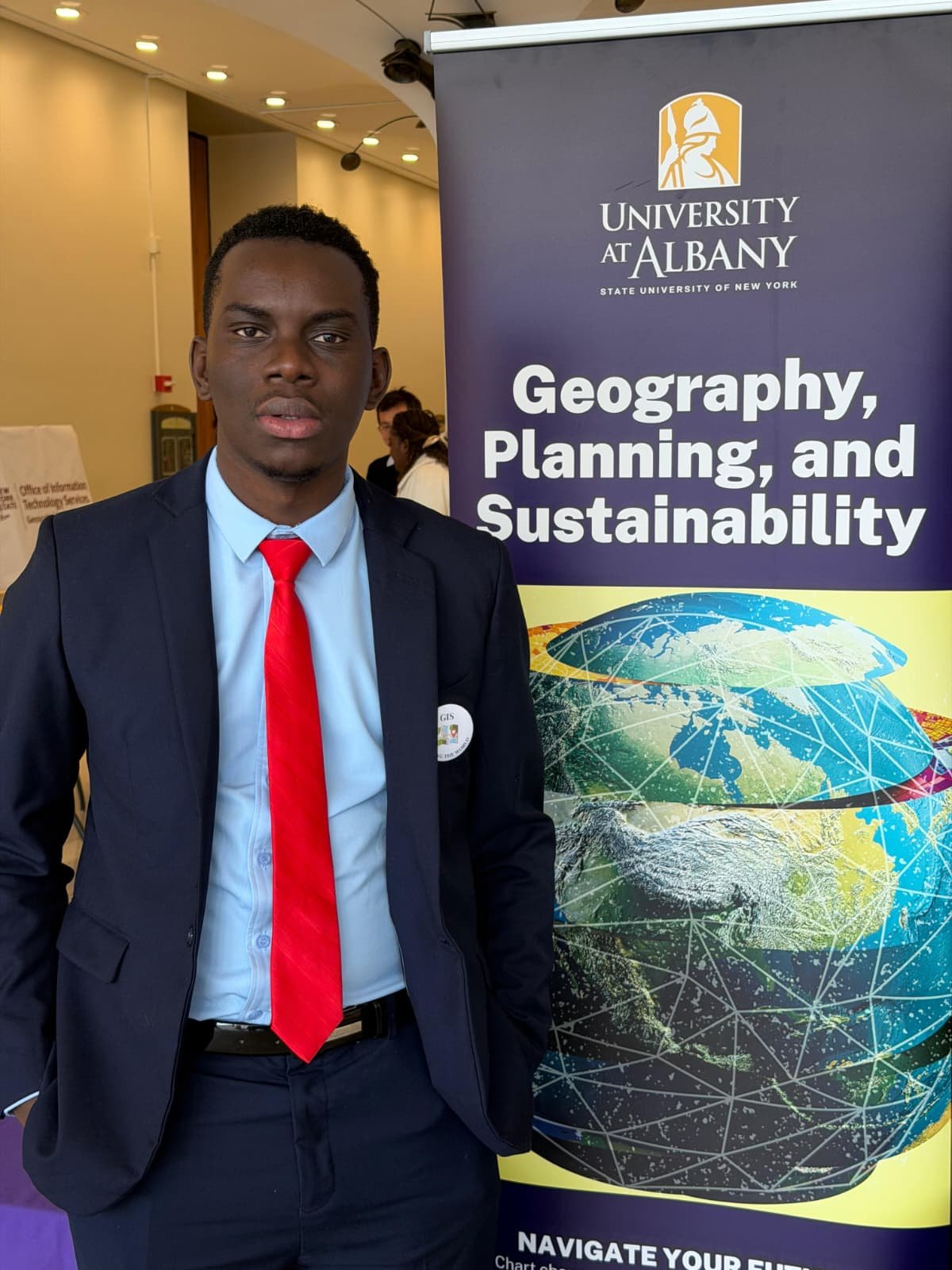
I'm Tanaka Kazonda. I use spatial analysis, remote sensing, and monitoring and evaluation to support environmental and development decision making. Currently a GIS Intern with the New York State Department of Environmental Conservation, Bureau of Real Property.

Tanaka Kazonda
Currently GIS Intern, New York State Department of Environmental Conservation
Studying M.S. GIScience, University at Albany (SUNY)
Focus Spatial analysis, remote sensing, M&E
Open to Internships, Research, Consulting
01

About

I'm a GIS specialist with three years of professional experience in monitoring and evaluation and a growing portfolio of applied spatial analysis work across the United States and Zimbabwe.

My focus areas include remote sensing, spatial statistics, kernel density and buffer analysis, probabilistic risk modeling, and applied GIS for environmental and development challenges. I work primarily in ArcGIS Pro, QGIS, Python, and R, and I have a strong grounding in monitoring and evaluation methodology from my prior work in the nonprofit sector.

I currently serve as a GIS Intern with the New York State Department of Environmental Conservation, Bureau of Real Property, where I support state level land management and conservation work. I am also completing a Master of Science in Geographic Information Science at the University at Albany, State University of New York.

Before relocating to the United States, I worked as a Monitoring and Evaluation Officer with SOS Children's Villages in Zimbabwe and supported community health and child protection research at St. Albert's Mission Hospital. I hold a Bachelor of Science (Honours) in Development Studies from Bindura University of Science Education.

02

Experience

2026, Present

GIS Intern

New York State Department of Environmental Conservation, Bureau of Real Property

  • Apply spatial analysis and remote sensing workflows to support state level land management, conservation, and real property work.
  • Process, clean, and visualize geospatial datasets in ArcGIS Pro and Python for internal reporting and decision support.
  • Contribute to GIS data management, map production, and quality control across project teams.
Jan 2026 Remote

Data Science Job Simulation

British Airways via Forage

  • Used Python to scrape and pre-process customer reviews, then built a Random Forest classifier to surface drivers of buying behaviour.
  • Modelled lounge eligibility at Heathrow Terminal 3 and translated findings into GIS applicable insights for demand mapping and route optimization.
Dec 2024, Jul 2025 Zimbabwe

Monitoring & Evaluation Officer

SOS Children's Villages

  • Developed monitoring and evaluation frameworks to assess program performance and outcomes.
  • Conducted quantitative and qualitative analysis using Excel, R, and SPSS.
  • Produced donor ready reports, evaluation summaries, and policy briefs.
  • Trained staff in data collection methods, research ethics, and results based reporting.
  • Presented findings to management and stakeholders to inform program improvements.
Aug 2022, Jul 2023 Zimbabwe

Field Research and Administration, Putting Children First Project

St. Albert's Mission Hospital, Community and Home Based Care

  • Administered psycho-social support to patients including ART, grief, and suicide counseling.
  • Conducted home visits with people living with HIV to assess welfare and provide referrals.
  • Led community dialogues on child protection, gender based violence, and gender equity.
  • Compiled field reports and supported preparation of evaluation presentations.
03

Education

2025, 2027 (expected)

Master of Science, Geographic Information Science

University at Albany, State University of New York

Coursework includes Remote Sensing I and II, Landscape Ecology, Programming for Spatial Data Science, Spatial Statistics, and GeoAI for Environmental Change and Adaptation. A grades across the first semester.

2024 Bindura, Zimbabwe

Executive Certificate, Sustainable Project Management, Monitoring and Evaluation

Bindura University of Science Education, awarded with Merit

2020, 2024 Bindura, Zimbabwe

Bachelor of Science (Honours), Development Studies

Bindura University of Science Education, Upper Second Class (2.1)

Selected coursework: Introduction to GIS, Mapping in Development Studies and Geosciences, GIS Applications in Development Studies, Environmental Impact Assessment, Disaster and Development, Research Methods.

04

Skills

GIS and Remote Sensing
  • ArcGIS Pro
  • QGIS
  • Google Earth Engine
  • PostGIS
Programming
  • Python
  • R / RStudio
  • SQL
Data and Modeling
  • Spatial Statistics
  • Kernel Density Estimation
  • Geographically Weighted Regression
  • LSTM and Time Series
  • Random Forest
  • SPSS
Research and M&E
  • Monitoring and Evaluation
  • Impact Assessment
  • Report Writing
  • Stakeholder Engagement
05

Projects

Urban Spatial Analysis

Green Space or Crime Space? A Spatial Analysis of Park Accessibility and Crime Patterns in Albany, NY

2025, SUNY Albany coursework

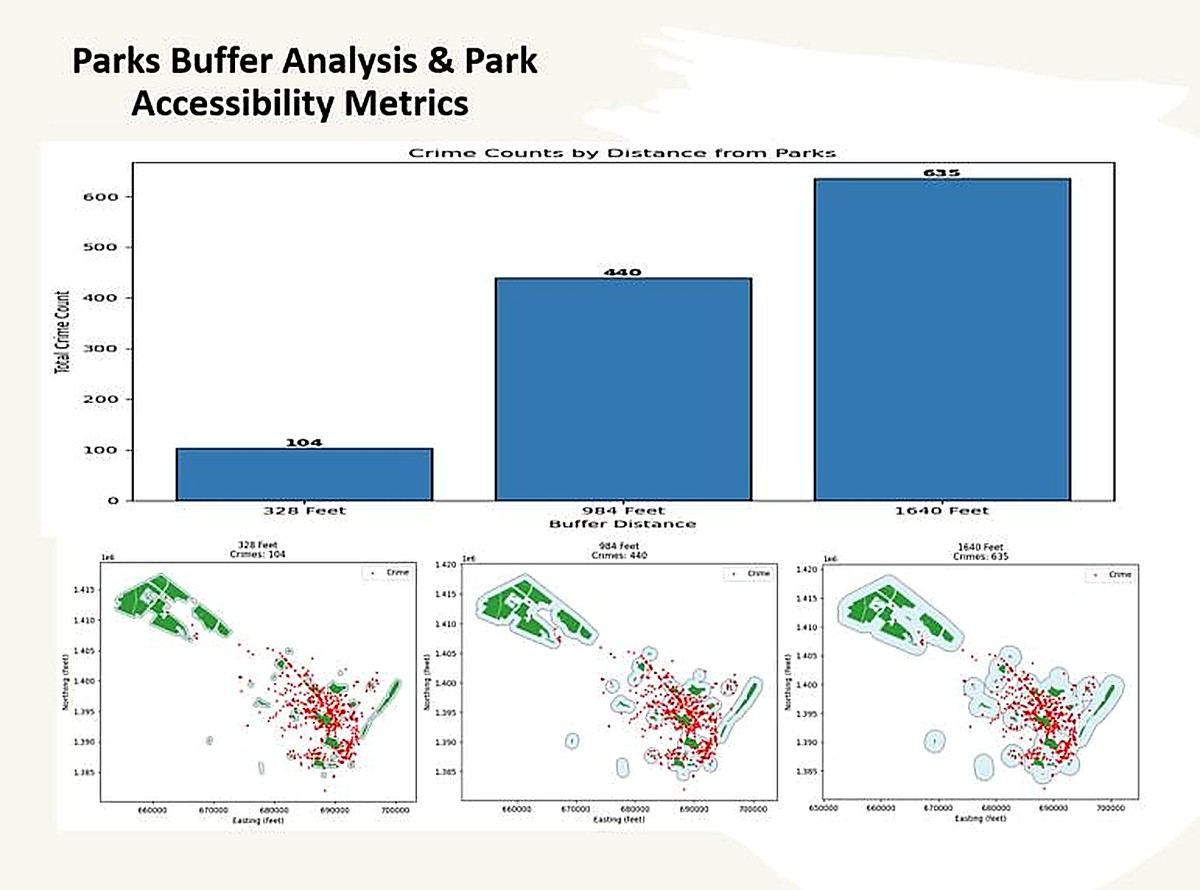
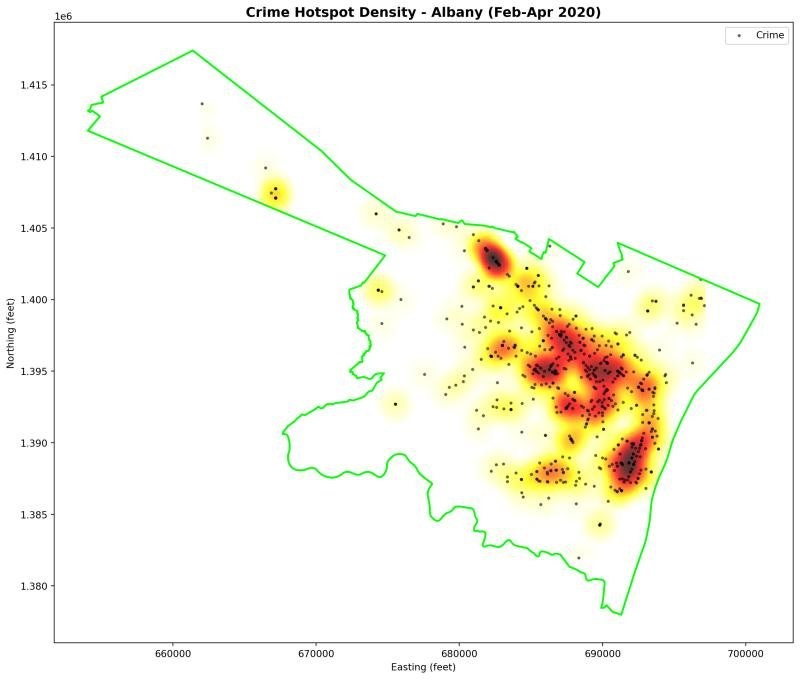
This project examined the relationship between park accessibility and crime patterns in Albany, NY. Using incident data from February to April 2020, I produced a kernel density estimation surface to map crime hotspots across the city. I then ran multi distance buffer analyses around every Albany park, at 328, 984, and 1,640 feet, to test how crime counts change with proximity to green space.

Crime counts increased with distance from parks: 104 incidents within 328 feet, 440 at 984 feet, and 635 at 1,640 feet. The finding suggests that Albany's parks are located in neighborhoods with lower crime density than surrounding areas, which runs counter to the common assumption that parks attract crime.

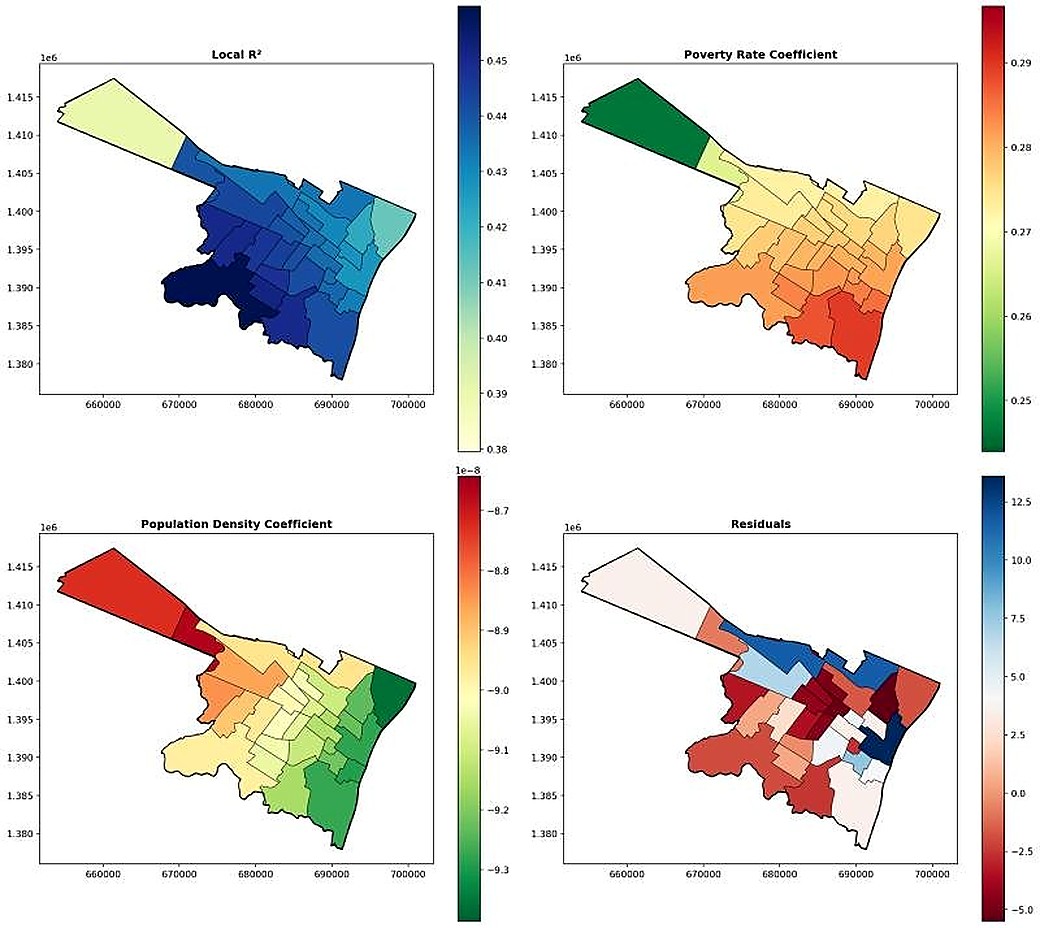
To go deeper, I fit a Geographically Weighted Regression model using poverty rate and population density as predictors of crime intensity. Local R squared values ranged from 0.38 to 0.47 across neighborhoods, with poverty rate emerging as a consistent positive predictor and population density showing a small negative effect. Residual maps revealed the spatial structure left unexplained, pointing to where additional covariates may matter.

  • ArcGIS Pro
  • Python
  • Kernel Density Estimation
  • Buffer Analysis
  • Geographically Weighted Regression
  • Albany PD data
Parks buffer analysis showing crime counts by distance from Albany parks
Crime counts by buffer distance from Albany parks
Kernel density estimate of crime hotspots in Albany, February to April 2020
Kernel density of crime incidents, February to April 2020
Geographically weighted regression of crime intensity in Albany showing local R squared, poverty rate coefficient, population density coefficient, and residuals
Geographically weighted regression: local R squared, poverty rate, population density, and residuals

Spatial Risk Modeling

Spatiotemporal Evolution and Probabilistic Spatial Risk Modeling of Wildfires in California (2000 to 2024)

2025, Independent research

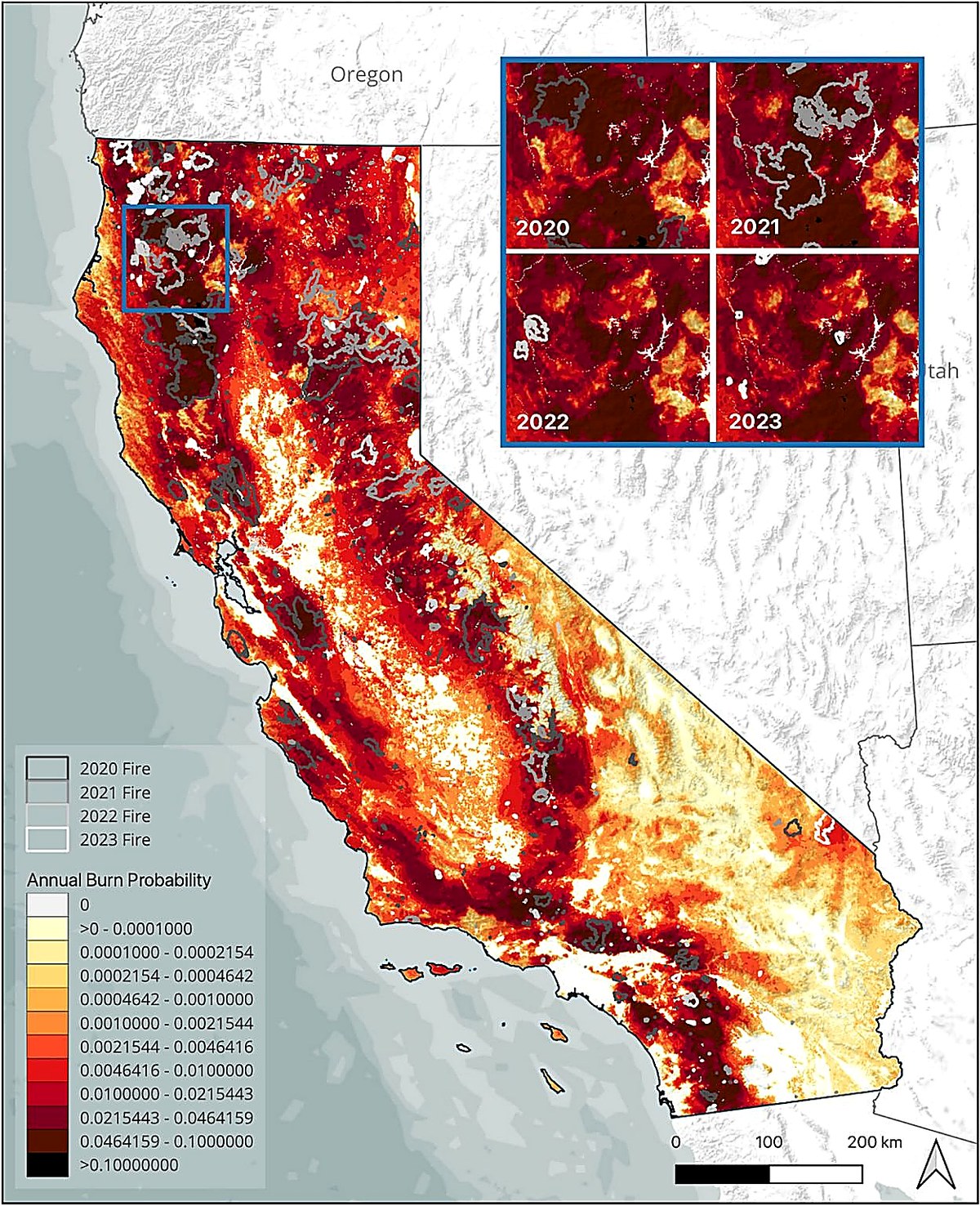
A 24 year analysis of wildfire risk across California. I assembled historical fire perimeters from CAL FIRE and integrated them with climate, terrain, and land cover data to produce annual burn probability surfaces at pixel level. The deliverable overlays modeled probability with observed fire footprints from 2020 to 2023, showing how risk concentrates in the northern Coast Ranges, the Sierra foothills, and the Transverse Ranges of Southern California.

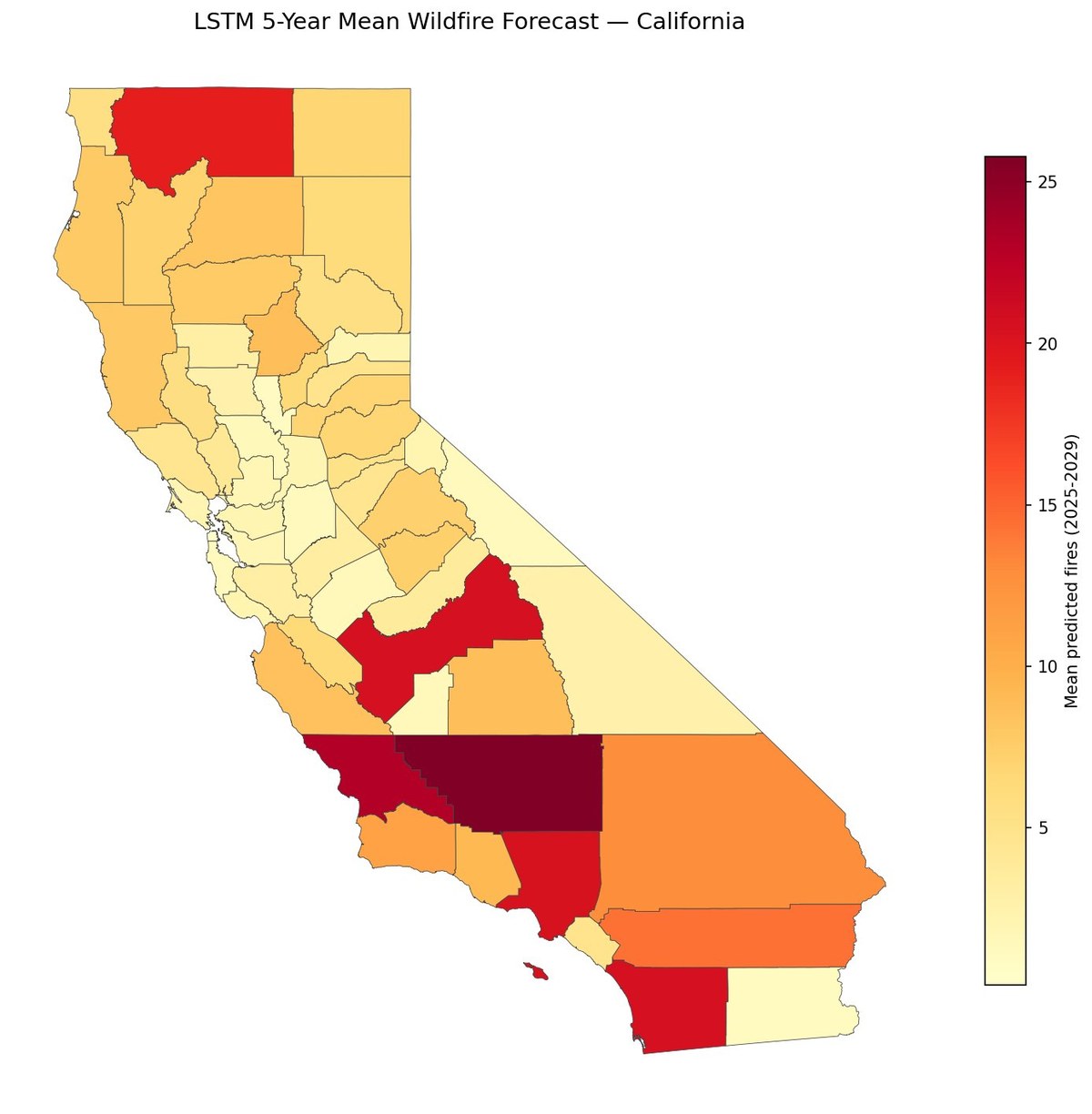
A companion forecast using a Long Short Term Memory neural network extends the analysis forward, projecting mean annual fire counts per county for 2025 to 2029. Together the two outputs give emergency managers a spatial probability surface and a forward looking county level signal to inform pre-positioning of resources.

  • ArcGIS Pro
  • Python
  • TensorFlow / Keras
  • GeoPandas
  • LSTM
  • CAL FIRE perimeters
Annual burn probability map of California with fire perimeters from 2020 to 2023
Annual burn probability with observed fire footprints, 2020 to 2023
LSTM five year mean wildfire forecast for California counties
LSTM forecast of mean annual fires per county, 2025 to 2029
06

Other Projects

Additional work from coursework and independent practice.

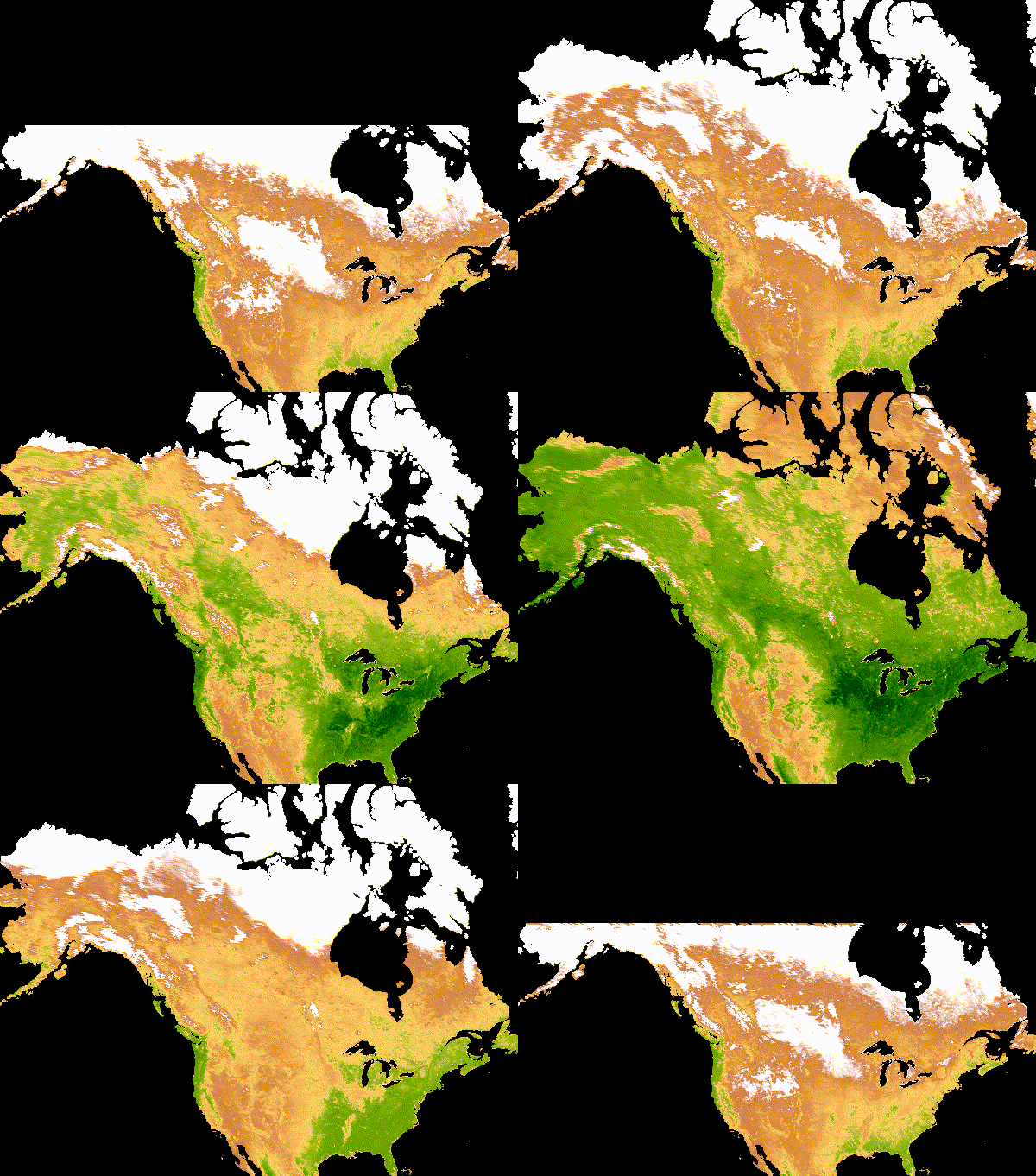
Animated NDVI phenology across North America

NDVI Phenology, North America

Animated time series of vegetation greenness across the continent, built from MODIS imagery in Google Earth Engine.

Google Earth Engine · MODIS · Python
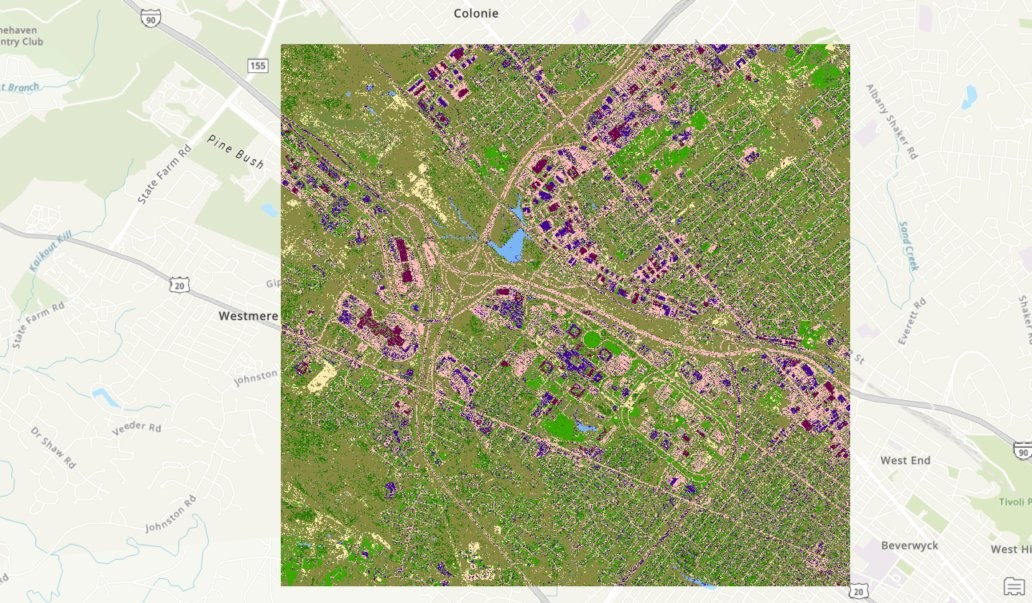
Supervised land cover classification of the Albany and Colonie area

Land Cover Classification, Albany and Colonie

Supervised classification of multispectral imagery to map impervious surfaces, vegetation, bare soil, and water across the Capital Region corridor.

ArcGIS Pro · Supervised classification
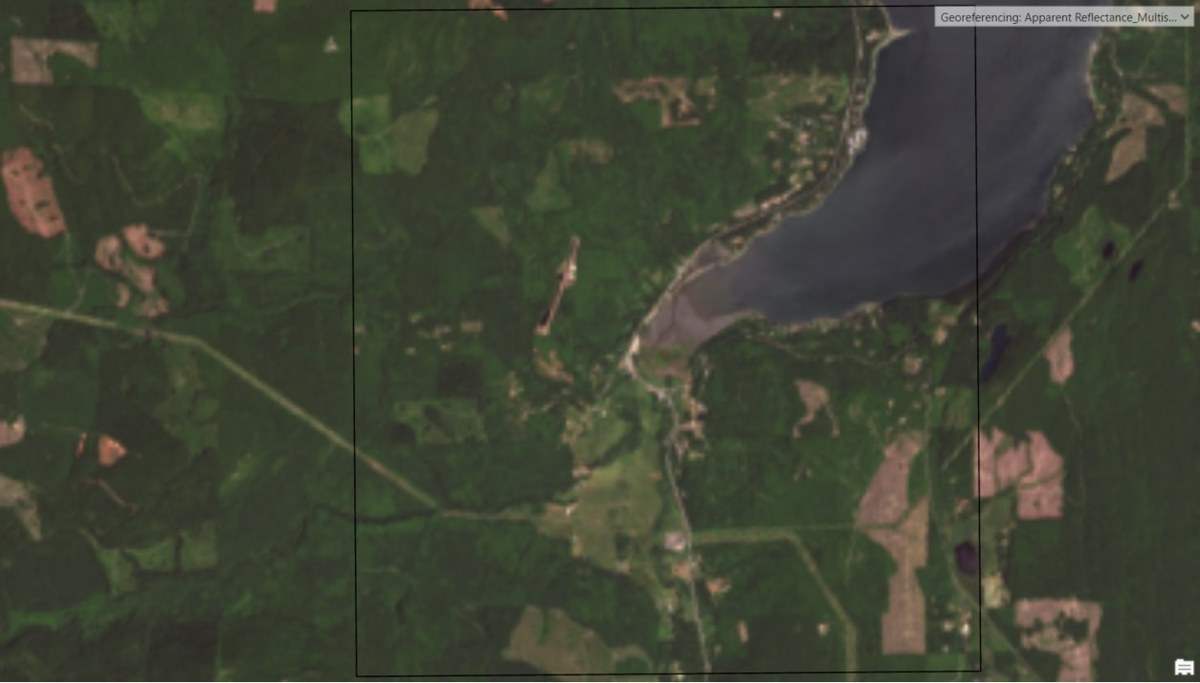
Multispectral georeferencing and apparent reflectance calibration

Multispectral Georeferencing

Calibrated and georeferenced a multispectral satellite scene over a forested lake region. Converted digital numbers to apparent reflectance and validated geometric accuracy with ground control points.

ArcGIS Pro · GCP validation
07

Contact

Open to opportunities.

I'm open to internships, research collaborations, and consulting work in GIS, remote sensing, and monitoring and evaluation. Email is the fastest way to reach me, and I usually reply within a day.